
How I Plan a High School Theatre Production (A Real Romeo & Juliet Walkthrough)
If you've ever stared at a blank calendar in August trying to figure out when auditions should happen, when to schedule tech week, and how on earth everything is supposed to fit before opening night — this one's for you.
In this video, I walk through exactly how I planned our production calendar for a one-act cutting of Romeo and Juliet. I'm teaching an advanced theatre production course on a 4x4 block schedule, which means I have my students every day for 90 minutes — and I'm working backwards from show night to figure out how to make it all work.
(And yes, Flat Shakespeare makes a cameo. He's a permanent fixture in my room at this point.)
Why I chose a cutting of Romeo and Juliet
I have strong opinions about full Shakespeare productions in high school… I have a Master's in Theatre Arts with an emphasis in Shakespeare studies, so this comes from experience. Since most high school programs don't need to attempt the full text., a well-crafted one-act cutting does everything you need it to do - it challenges your actors, it's intellectually rigorous, and it gives your design students something beautiful to work with.
For this production, I found a 60-minute cutting through Theatrefolk.com, which is one of my absolute favorite resources for theatre teachers. It's still Shakespeare's language, just edited for time and accessibility. My goals were clear - give my students a real acting challenge, intellectually stretch them, and do something different for our community, which studies Romeo and Juliet in 9th grade English. Classical theatre is a gift to an audience that's used to the new stuff.
How I built the calendar
Here's my process, which I walk through in real time in the video:
•Start with the fixed dates first. I wrote in our first day of school, our show date, and all performing arts calendar dates before anything else. These are non-negotiables.
Work backwards from opening night. I blocked out show week and the week before for tech and dress rehearsals. On our schedule, dress rehearsals run 4–7 PM after students have already had a 90-minute class period, so they arrive in costume and aren’t starting from scratch.
Count your rehearsal weeks. I had about six weeks of in-class rehearsal before tech. On a block schedule, that's more time than it sounds.
Build in your milestones. Table read by the end of the first week. Auditions and casting on day two. Off-book deadline. Stumble-through. Run-through. Set build day. Costume test day.
Give students the calendar from day one. Students get a printed calendar in their script packet on the first day of class, plus a QR code to a Google Calendar and a shared Google Classroom for announcements. Parents get access too.
The biggest lesson from this planning session
I had 22 scenes to get through in roughly 5–6 weeks of active rehearsal. That math is humbling. Planning it out in front of you (on paper, in real time) is the only way to make sure you're not kidding yourself about what's actually achievable. The calendar is your reality check before the reality hits.
Watch the full video for the complete walkthrough, including how I divide scenes across weeks, when I schedule the stumble-through and run-through, and what goes into a first-day packet for a production course.
Want a ready-made production calendar template you can customize for your own show?
The Director's Production Playbook includes a full production calendar template - along with audition applications, crew forms, a production contract, and more. Everything you need to run a professional production from auditions to curtain call.
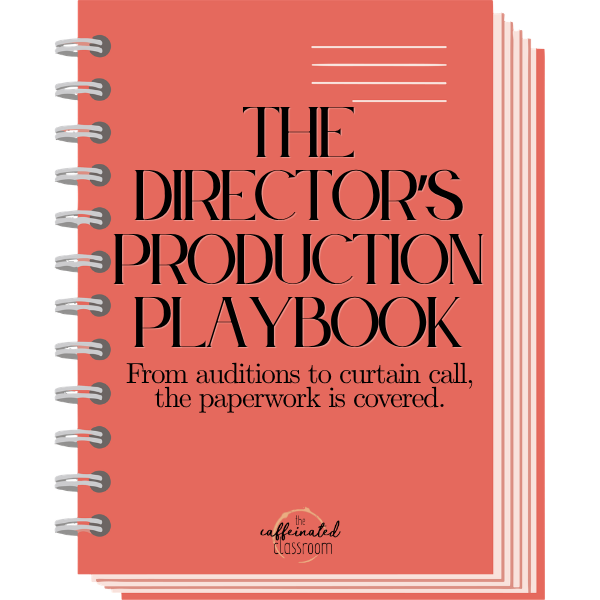
THE DIRECTOR’S PRODUCTION PLAYBOOK
From auditions to curtain call, the paperwork is covered.
And if you want an entire library of theatre classroom resources - units, lessons, production systems, and more - come take a look at The Drama Teacher Lab. It's everything I've built over 19 years of directing, organized and ready for you to use.