
Where I Find Lesson Inspiration When the Creative Well Runs Completely Dry
I am a teacher who is energized by creativity - by finding the weird connection between an unexpected source and a unit I'm planning, by the moment something I see in the world clicks into place as a lesson. That well has been running low. And I suspect I'm not the only one.
So I want to share four places I've been going lately when I need to refill it. Some of these are going to make complete sense. At least one is going to surprise you.
1. Children's books
I already told you about Cloudy with a Chance of Meatballs — the picture book I read aloud to my American Literature class as a hook for a Declaration of Independence unit. I want to underscore the principle behind that lesson: children's books are built around big ideas in their most distilled form.
When I need inspiration, I open a picture book or two and ask: what is this book really about? What is the big question underneath the story? And then: what text am I teaching where that question lives? The connection usually reveals itself faster than you'd think.
2. TED and TED-Ed
I keep a running list of TED and TED-Ed talks that catch my attention - not talks I'm searching for intentionally, but ones that pop up when I'm just browsing. Some recent ones that have made it into my classroom:
What role does luck play in your life (Barry Schwartz) - I used this around St. Patrick's Day as a quick entry point into a conversation about luck, privilege, and how much of our circumstances we actually control. Students had a lot to say.
A playlist of TED Talks on privilege - Four or five short talks compiled around the theme of privilege. Going into my classroom next year as part of a unit on perspective and power.
The key is not searching for talks about the topic I'm teaching. It's staying open while I scroll and letting things pop up. Inspiration finds you much more reliably when you stop pushing and start noticing.
3. Instagram - and yes, the reels
A few categories of content that have been genuinely inspiring lately, not just algorithmically satisfying:
Farm accounts (@farm.lux and @happydaysfarm) - I am completely serious. Something about nature, animals, and pretty pictures of eggs clears the cobwebs in a way that nothing else does. It's a defrag. It creates space for other things to come in.
Authors I admire - Victoria Aveyard (Red Queen series) and Nic Stone (Dear Martin) both post thoughtfully about writing, amplifying marginalized voices, and the work behind the books. Following the humans behind the books my students love adds a layer that makes the classroom experience richer.
Cosplay reels - This is the one that surprised me too. I started watching cosplay reels where creators lip-sync to movie audio while playing multiple characters, and something about the format sparked a classroom idea: what if students created social media profiles for characters in their book club novels and performed scenes from the character's perspective? Students started that project today. It came entirely from a cosplay reel.
The bigger principle
When I am actively hunting for inspiration, it almost never comes. When I open myself up to receiving it - while doing something adjacent, something restful, something totally unrelated - it arrives.
The four places I've described are not lesson planning tools. They're well-filling tools. They're where I go when I need to stop pushing and start receiving. The lessons follow on their own.
Watch the full video for the complete breakdown and a few more specific examples - including the 60 Minutes interviews and NPR podcast episodes that have been finding their way into my units lately.
Looking for a more structured approach to unit design and lesson planning?
LIT 108: The Design Studio at BNT University steps inside our planning process as Amanda and I deconstruct traditional chapter-by-chapter units and rebuild them with modern inquiry. It's one of the most useful things we've made for teachers who feel stuck in old patterns. Free at the 100 level.

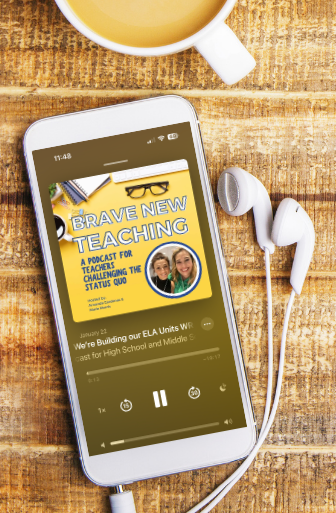
And for a weekly dose of ideas, conversation, and honest teaching talk - the Brave New Teaching podcast is exactly that.